Classical molecular dynamics spends much of each timestep on long-range electrostatics: every charged atom interacts with every other, in principle. Liang et al. (Flatiron Institute) reported a faster Ewald-class method that LAMMPS has accepted. A small crystal-melt run on QuickMDSim shows the surrounding workflow, not the new kernel (that kernel is not in the 22 Jul 2025 image yet).
The method
Nature Communications (May 2026): Jiuyang Liang and colleagues (Shidong Jiang, Alex Barnett, Leslie Greengard, and others) report classical MD 2.5–7× faster at the same accuracy. For GROMACS at high accuracy they measured about 5×. The LAMMPS developers have accepted the implementation.
Why electrostatics dominate
MD advances time in femtosecond steps. A microsecond of simulated time is on the order of 10⁹ steps. Coulomb interactions fall as 1/r, so a naive sum over atom pairs scales as N². Fast Fourier (PPPM/PME) and fast multipole methods reduce that, but the long-range piece is still most of the wall time in polar or charged systems.
The Flatiron work uses prolate spheroidal wave functions (19th-century special functions, later used in signal processing) to split short-range and long-range electrostatics and to spread charges onto the grid. The functions are both spatially localized and smooth, which older splitters trade off. The potential that must be transformed is less peaked, so the grid work is cheaper at the same error.
"There are so many fields in science that rely on molecular simulations that can now take less energy and computing time." — Shidong Jiang, Flatiron Institute
Illustration on a cloud LAMMPS runner
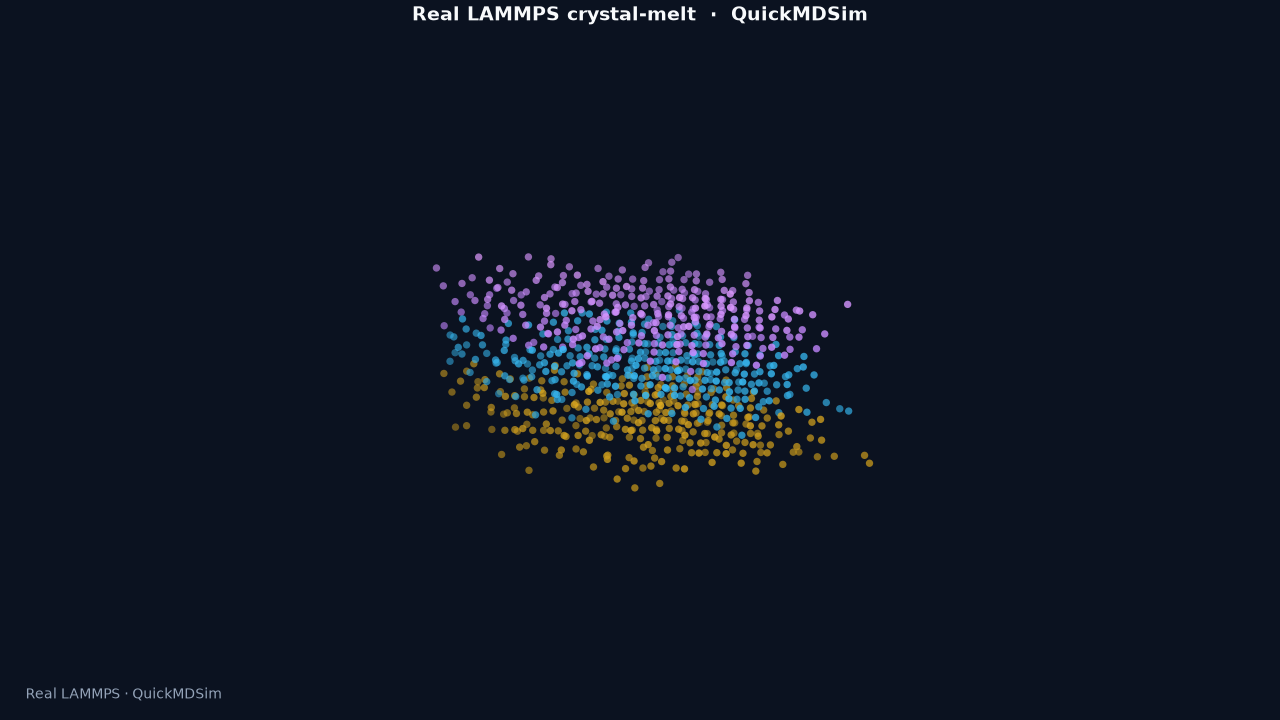
The trajectory below is not a test of the new Ewald method. It is an 864-atom Lennard-Jones FCC crystal (three colored slabs) that is equilibrated cold, heated through melting, then sheared. It ran with LAMMPS on QuickMDSim. Lennard-Jones is short-ranged; the point is the dump-to-browser path, not a Coulomb benchmark.
Loading 3D trajectory…
Drag to rotate · scroll to zoom · right-drag to pan · Space to play/pause
Create a project, paste the input, submit, download
dump.shear_melt.lammpstrj. When the accepted Ewald code lands
in a LAMMPS release we ship, charged systems on this runner inherit it
without a new input language.
Open the app or email.