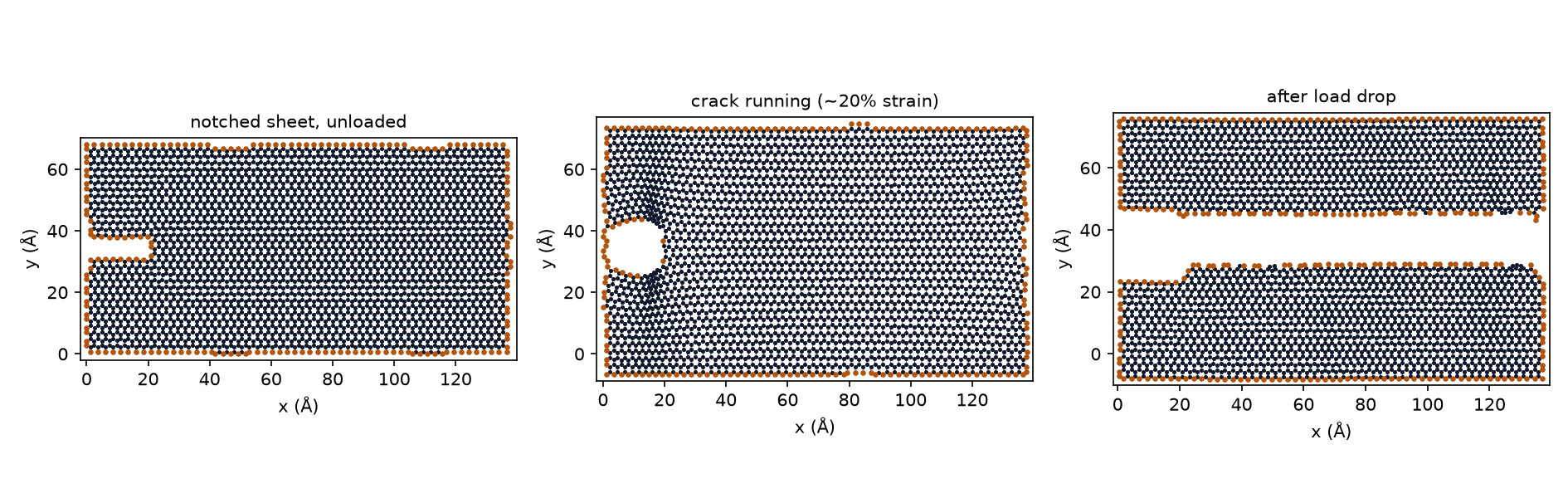
An edge-notched graphene sheet is stretched in the armchair direction until the far-field stress collapses. The honeycomb, the notch, and the crack path are in the dump file (the trajectory of atom positions), not inferred from a finished-job status.
Methods
3,533 carbon atoms in one graphene layer (orthogonal four-atom cell,
C–C = 1.42 Å). Periodic boundaries and about 32 Å of vacuum in
z. An edge notch about 20 Å deep was deleted from the left
free edge. The potential is Tersoff carbon
(J. Tersoff, Phys. Rev. B 39, 5566 (1989);
errata 41, 3248 (1990)), file SiC.tersoff,
pair_coeff * * SiC.tersoff C. Units metal; timestep 1 fs.
After minimization and a short 10 K hold, the box was extended in
y at engineering strain rate 0.005 ps−1 with
fix deform and an NVT thermostat at 10 K.
The calculation is in the same class as Omeltchenko, Yu, Kalia, and Vashishta, Phys. Rev. Lett. 78, 2148 (1997): a graphite sheet, a notch, and a crack that can be counted along in the lattice. It is not a three-dimensional displacement cascade.
Results
Cohesive energy after minimize is −7.33 eV/atom (Tersoff C). During loading the far-field stress in y rises to about 9.5 GPa near 19% engineering strain, then collapses over the next ~1% strain as the notch opens and the sheet separates. Kinetic temperature stays near 10 K until the break, where it spikes (dissipated bond energy) and falls. Atom count is constant (3,533). Neighbors per atom remain about 9 on the full Tersoff list (three bonded neighbors plus farther shells inside the cutoff).
9.5 GPa is not the ~100 GPa strength of pristine graphene in AFM (Lee et al., Science 321, 385 (2008)). This sheet is notched, the strain rate is MD-fast, and Tersoff C is a short brittle potential. The figure is the crack path, not a strength number.
Cloud GPU runner
The job ran on QuickMDSim, a cloud LAMMPS runner. LAMMPS 22 Jul 2025,
Kokkos 4.6.2, pair tersoff/kk on device, one MPI rank, one
NVIDIA L4. Wall time 21 s. Credits are billed at 12× a 1-core CPU
second. KOKKOS is the LAMMPS GPU path; the input does not contain
/kk or -k on because the GPU runner injects those
flags. GPU is Pro-only. Free and Basic stay on CPU. ReaxFF, MEAM, and
machine-learned potentials are not in either image. See
GPU (KOKKOS) and
citing LAMMPS.