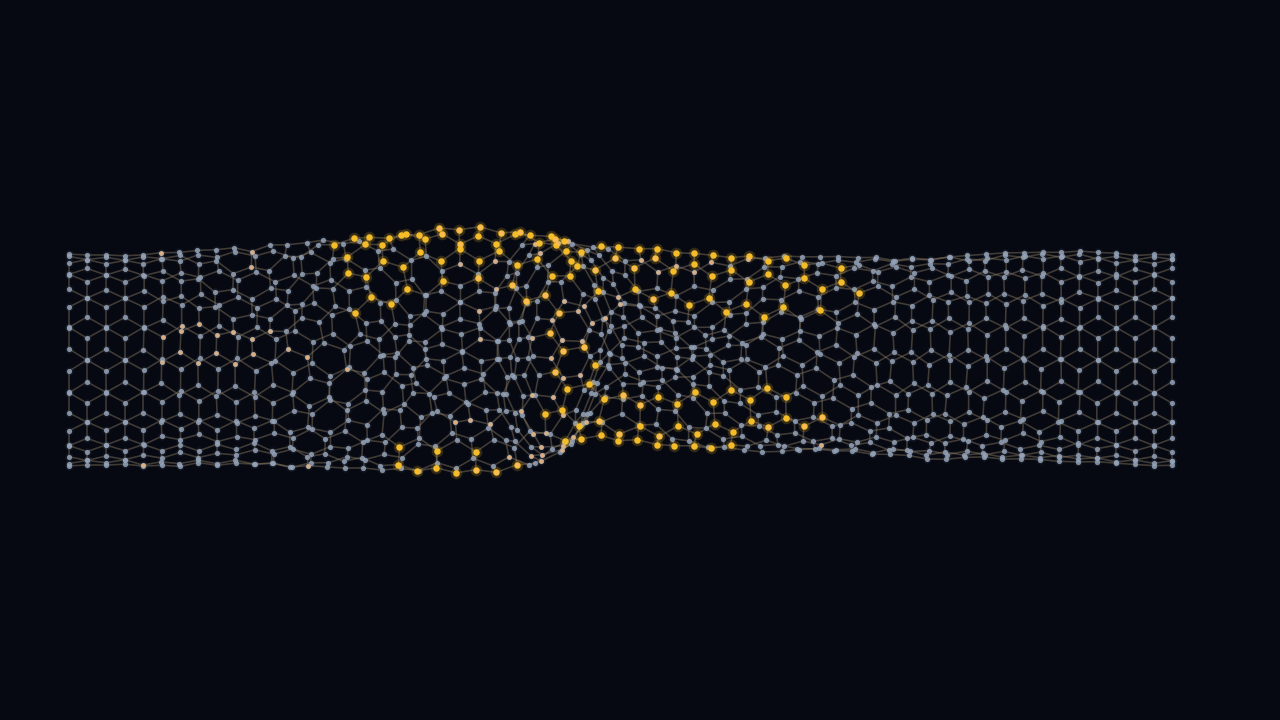
A thin carbon nanotube under end compression does not remain a cylinder. It kinks. Continuum shell theory predicted that shape; molecular dynamics with a Tersoff lattice shows it atom by atom.
Loading 3D trajectory…
Drag to rotate · scroll to zoom · right-drag to pan · Space to play/pause
Background
A thin cylindrical shell under axial load flattens and then kinks at a few percent strain. Yakobson, Brabec, and Bernholc (Phys. Rev. Lett. 1996) showed that a Tersoff carbon nanotube does the same on the lattice. Iijima, Brabec, Maiti, and Bernholc reported the flexibility in TEM and in MD the same year.
The potential is Tersoff carbon
(Tersoff, Phys. Rev. B 1989),
the same C–C parameters as the graphene-fracture note. The file
SiC.tersoff is a project file, not baked into the container.
Methods
A (10,10) armchair tube (1,280 atoms, 78.7 Å long, radius 6.78 Å) was submitted from app.quickmdsim.com and run with LAMMPS in a cloud container on one CPU core (37 s wall time).
- Bottom rings frozen. Top rings driven at −0.40 Å/ps for 24 ps.
pair_style tersoffwithSiC.tersoffC.- Project files:
input.lammps,data.lammps, potential.
What the dump shows
A completed job is not the result. From dump.buckle.lammpstrj:
-
Radial envelope
rmax = max √(x²+y²)sits at 7.1 Å through 3.5% strain (still a cylinder, plus a 0.22 Å seed used to pick a buckle plane). - Between 3.7% and 4.2% strain, rmax jumps 7.4 → 10.6 Å. Thermo pressure collapses in the same window.
- After the jump the mid-span stays at 10–11 Å. The caps stay at ~7.3 Å, so the extra radius is in the middle of the tube.
That is the Yakobson picture at educational scale: a Tersoff lattice that leaves the cylinder past a few percent of end shortening.
Product notes
Tersoff needs SiC.tersoff next to the input. QuickMDSim copies
every project file into the job working directory. The 3D player on this
page reads a normal dump custom
(dump.qmd3d.lammpstrj, id type x y z), the same
file as Outputs after you run the starter.
Files
Repo path demos/cnt-buckle/:
input.lammps, data.lammps,
SiC.tersoff, README.md.
Regenerate the tube with python3 scripts/gen_cnt_buckle.py.
The app starter is named CNT buckle.
- Open app.quickmdsim.com
- Pick CNT buckle
- Run (about 45 s on one CPU core)
- Open
dump.qmd3d.lammpstrjin the player, or colordump.buckle.lammpstrjby √(x²+y²)
Educational tube, sized for the free tier. Cite Yakobson et al. (1996), Iijima et al. (1996), and Tersoff (1989) if you take the geometry into research. This is not a reproduction of a production trajectory from those papers.